Onion-foot Honey Fungus (Armillaria cepistipes)
Index Fungorum Armillaria cepistipes Velen.
MycoBank Armillaria cepistipes Velen.
Onion-foot Honey Fungus.
Cēpistīpes — mycological: with a thickened stipe base, bulbous-stemmed. From cēpa (onion) + stīpes (stipe).
Armillaria cepistipes f. pseudobulbosa Romagn. & Marxm., Bull. Soc. Mycol. France 99: 314 (1983)
Armillaria cepaestipes Velen., České Houby 2: 283 (1920) [MB#251373]
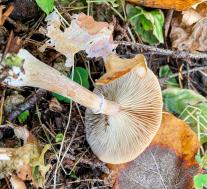
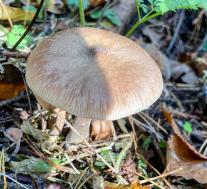
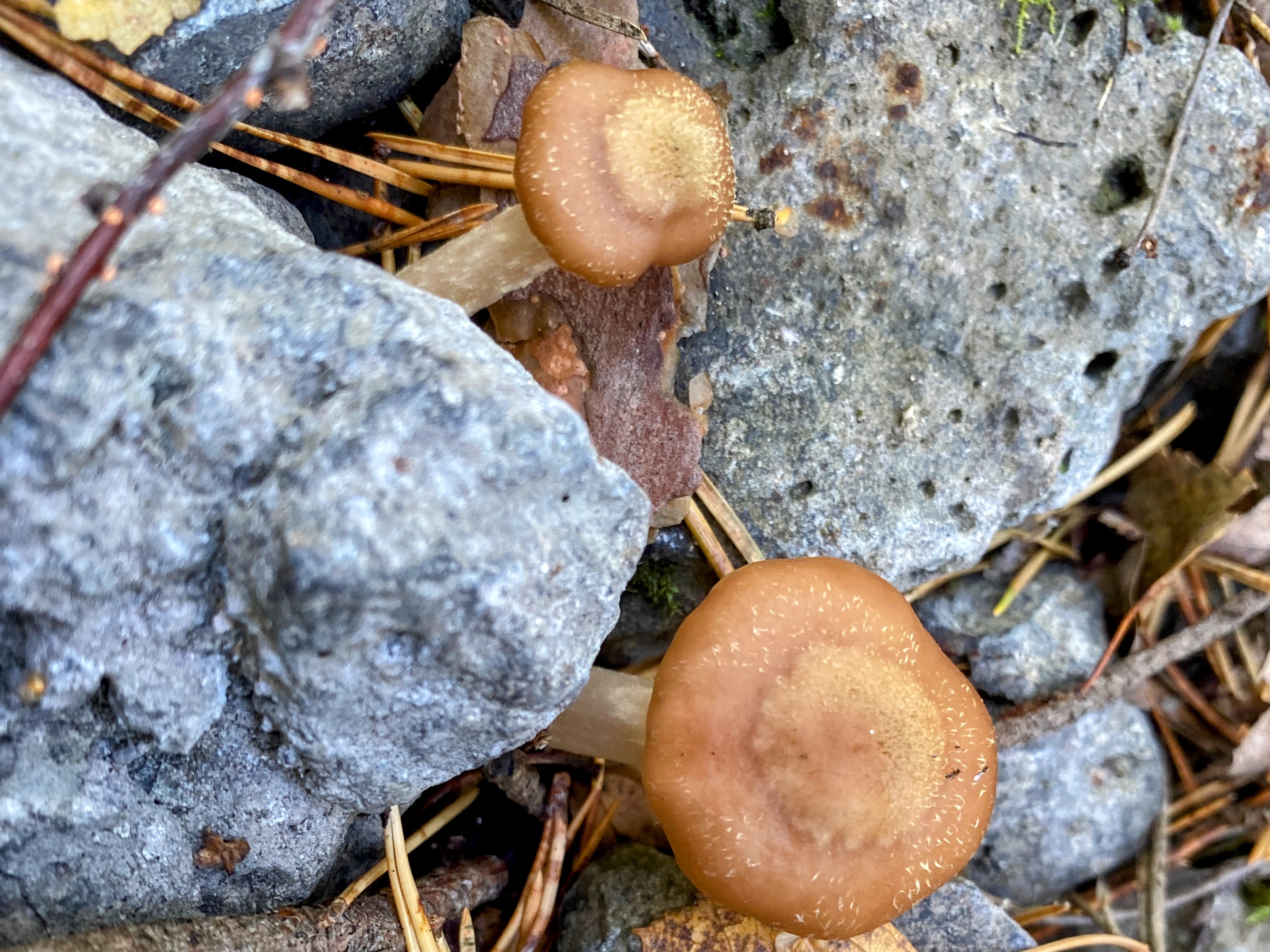
A characteristic feature of *Armillaria cepistipes* is a weakly expressed partial veil, which may disappear entirely over time. Perhaps this is the only criterion by which this honey mushroom can be distinguished, albeit with some reservation, from *Armillaria gallica*, which has a cottony and extensive partial veil.
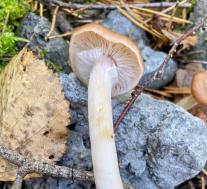
From hemispherical to completely expanded, diameter varies widely, from 3 to 10 cm. Margin thin, ribbed (gills visible through the edge). Color usually inconspicuous, ranging from nearly white to grayish-yellow. Scales on the cap are not as dense as in other Armillaria species, and in mature specimens may be washed away by rain, especially in the central area. Gills relatively crowded, decurrent; in young specimens they may be strictly white, but with age, like in other honey mushrooms, they darken and become covered with brown spots. Partial veil membranous, whitish, quickly tearing; ring narrow, collar-like, usually disappearing in maturity.
1–8 cm long and 0.5–2.5 cm in diameter, cylindrical, more or less swollen at the base; in specimens growing on substrate buried in soil, the swelling may be inconspicuous. Stipe color: light, whitish near the gills at the top; below, grayish-brown to dirty brown. Stipe surface: bare and smooth near the gills at the top; below the ring, covered with large light fibrous scales or appressed light fibers, sometimes disappearing over time. Stipe solid. Numerous yellowish scales are located below the ring and persist for a long time.
In the stipe: fibrous, tough. In the cap: thin, soft. White when broken. Taste pleasant or slightly astringent.
Mushroom-like, pleasant.
Spore print white. Spores broadly ellipsoid to nearly spherical.
Armillaria cepistipes typically grows on remains of deciduous trees, on heavily decayed fallen wood, and abundantly on buried wood beneath the soil cover or on tree roots.
All honey mushrooms of the genus Armillaria are very similar to each other.
Honey Fungus (Armillaria mellea) grows in the southern and extreme western regions of our country.
Northern Honey Fungus (Armillaria borealis) has a more pronounced and durable veil that always remains as a ring on the stipe. Northern Honey Fungus grows in large clusters.
Inexperienced foragers may also confuse honey mushrooms with various Pholiota species, which are distinguished by more pronounced scales and a bitter taste.
Possesses bioluminescent properties.
Add new comment