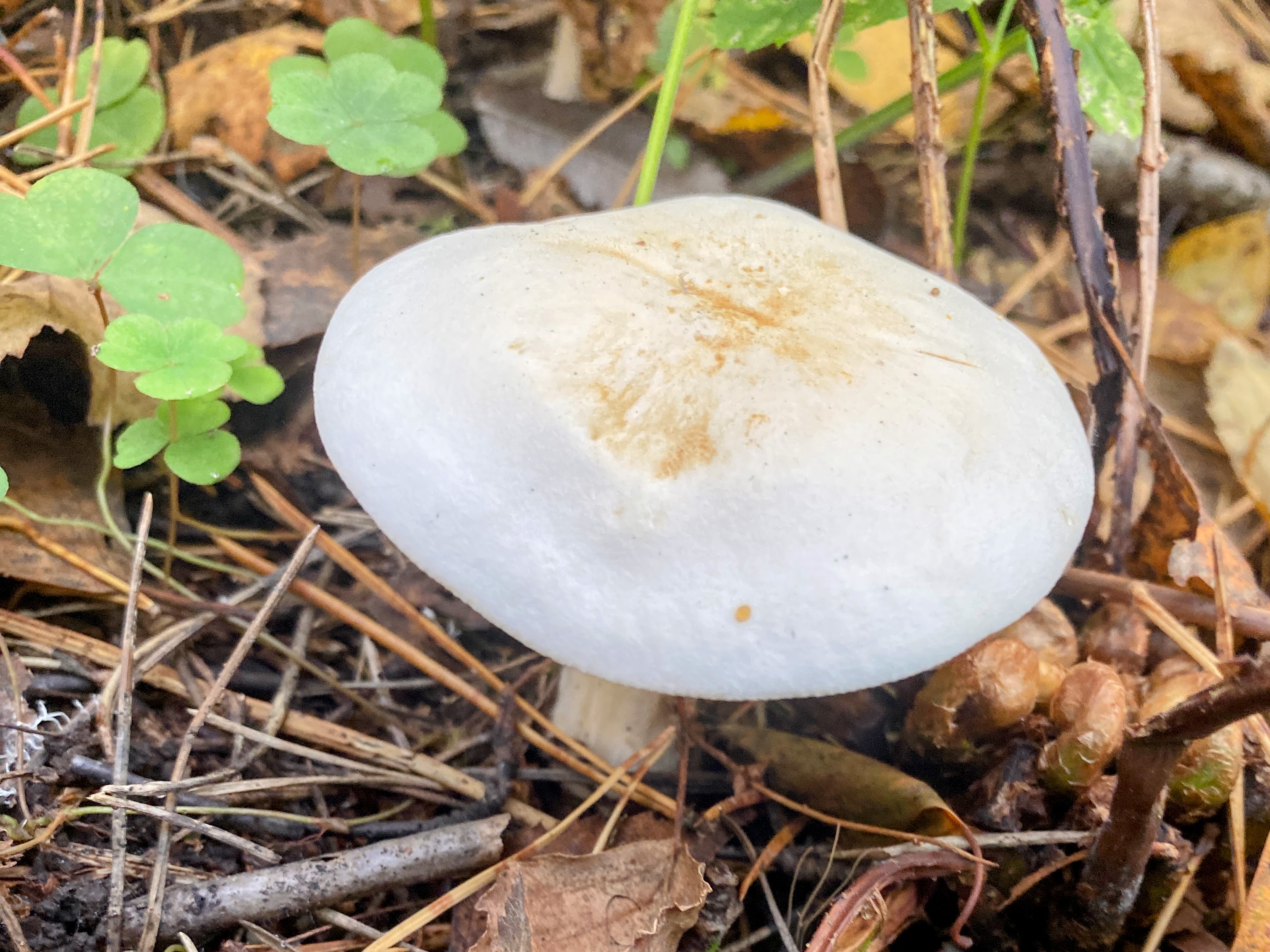
Close-gilled Knight (Tricholoma stiparophyllum)
Index Fungorum Tricholoma stiparophyllum (N. Lund) P. Karst
MycoBank Tricholoma stiparophyllum (N. Lund) P. Karst.
Pseudo-white Knight.
Stiparophyllus, a, um, myc. having crowded gills, close-gilled.
Agaricus stiparophyllus N. Lund, Consp. Hymen. Holm (Christianiae): 10 (1845)
Tricholoma pseudoalbum Bon, Bull. trimest. Soc. mycol. Fr. 85(4): 486 (1970) [1969]
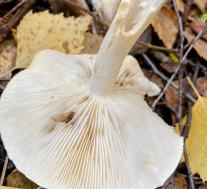
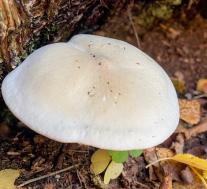
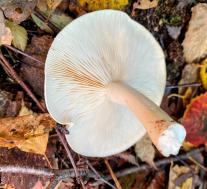
This is precisely the mushroom that, strictly speaking, is not a toadstool, but fully deserves such a folk name. First and foremost, the most noticeable feature of the Close-gilled Knight is its odor. Sharp, unpleasant, chemical. In various sources it is described differently: from rot to stench, but to the author, the smell of the Close-gilled Knight most closely resembled the odor of DDT diluted with acetone.
4–15 cm in diameter. In youth bell-shaped or convex. Later becoming flat-expanded or flat-convex. Often with a broad umbo in the center or without one. The cap margin remains inrolled downward for a long time, becoming wavy at maturity. In old fruiting bodies the margin may be turned outward. Cap surface smooth or velvety. In young specimens the cap is white, creamy, or fawn-colored; in more mature specimens with yellowish or brownish spots and various shades, especially in the center of the cap.
Gills adnate or adnate with a tooth, moderately crowded, white or beige. With age or in damaged areas developing brown spots.
5–12 cm long and 1–3 cm in diameter, cylindrical or slightly widening toward the base. Often with mycelial cords at the base. Surface pale or white-yellow, smooth. In the lower part sometimes with yellowish or brownish spots.
Firm, dense. White or light yellow in color. Taste bitter, astringent.
Unpleasant chemical odor, with floral notes, intensifying with age.
Spore print: white. Spores ellipsoid, smooth.
Grows in groups. Associated with small-leaved trees, mainly Betula. Widespread.
There are quite a few similar species, both edible and inedible. Among the edible ones are various Agaricus species, distinguished by the presence of a ring on the stipe, pink or brown gills, and a more pleasant odor.
The edible St. George's Mushroom (Calocybe gambosa) differs by a more asymmetrical habit and a pleasant farinaceous odor. Moreover, the standard fruiting period for St. George's Mushroom is May–June. The Dove Knight (Tricholoma columbetta) also differs by a more pleasant odor and a wavy cap margin, and its gills are more sparse and broad.
An almost identical inedible look-alike is the White Knight (Tricholoma album), which grows mainly near oak in warmer regions. The Foul-smelling Knight (Tricholoma inamoenum) is also an inedible mushroom with more sparse gills, inhabiting moist coniferous taiga forests.
Add new comment