Yellow-brown Knight (Tricholoma fulvum)
Index Fungorum Tricholoma fulvum (DC.) Bigeard & H. Guill.
MycoBank Tricholoma fulvum (Fr.) Bigeard & H. Guill
Sulfur Knight (Tricholoma fulvum)
Fulvus, a, um: reddish-yellow, dark yellow, tawny; yellowish-brown.
Agaricus fulvus DC., in Lamarck & de Candolle, Fl. franç., Edn 3 (Paris) 2: 186 (1805)
Gyrophila fulva (DC.) Quél., Enchir. fung. (Paris): 11 (1886)
Tricholoma flavobrunneum (Fr.) P. Kumm., Führ. Pilzk. (Zerbst): 130 (1871)
Tricholoma nictitans (Fr.) Gillet, Hyménomycètes (Alençon): 93 (1874)
Gyrophila nictitans (Fr.) Quél., Compt. Rend. Assoc. Franç. Avancem. Sci. 22(2): 485 (1894)
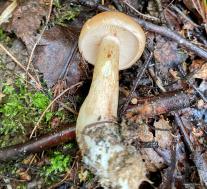
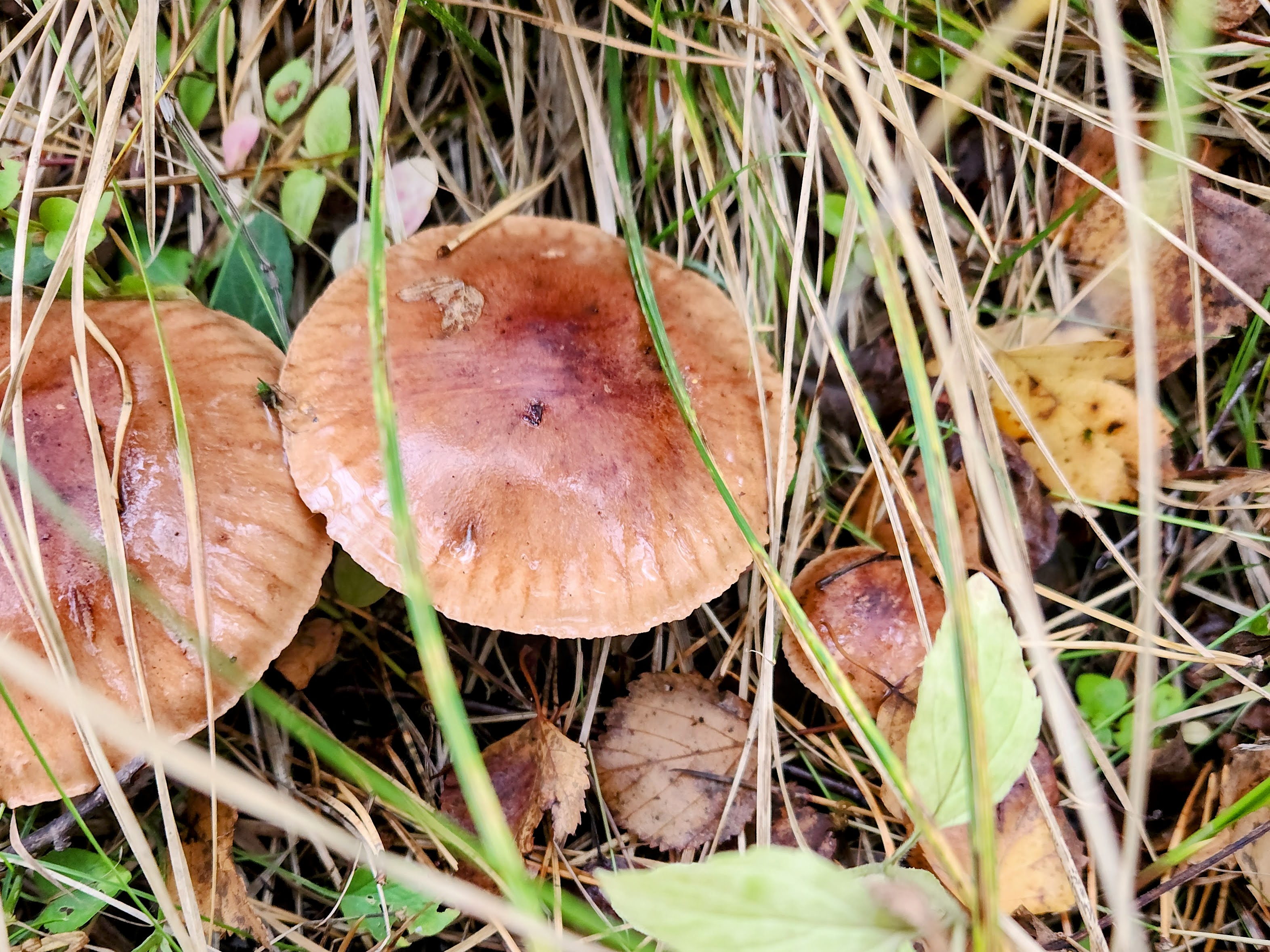
An unremarkable representative of the knight mushrooms (Tricholoma). In the Yaroslavl region of Russia, it is called "meadow honey mushroom" (луговой опёнок), while in the Tula region it is known as "ryzhik" (a name typically reserved for the prized Saffron Milk Cap, Lactarius deliciosus). Why these names are used? We will probably never know.
In English, the colloquial name for this mushroom is Birch Knight.
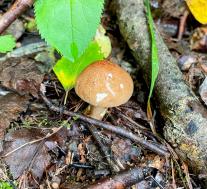
3–15 cm in diameter, initially broadly conical or hemispherical, with the margin incurved; as it matures, it expands to plano-convex and spreading, with a broad umbo in the center. The margin straightens and in old fruiting bodies becomes striate, ribbed. The surface is smooth, with radially arranged fibers that in dry weather turn into appressed soft scales, and is sticky when moist. Coloration is uneven — darker in the central part, orange-brown or brown, becoming lighter toward the margin, predominantly yellowish-brown or brown.
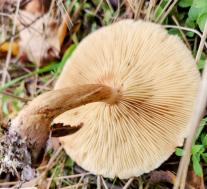
Gills emarginate-adnate, light yellow to sulfur-yellow, with age acquiring pinkish tones and becoming covered with brown spots along the margin.
3.5–12 cm long, 0.4–2 cm in diameter, cylindrical or expanding downward. The surface is light, white with darker longitudinally arranged fibers that may peel off, turning into small scales. In the upper part, the fibers are light, pinkish; downward they darken to yellowish-brown or reddish-brown.
In the cap, white; in the stipe, straw-yellow to sulfur-yellow. Taste bitterish, mealy (floury).
Weakly expressed, floury (mealy), intensifying when broken or cut.
Spore print white. Spores broadly ellipsoid to ellipsoid.
A soil-litter mycorrhizal former. Grows in scattered or dense groups, rows, arcs, or "fairy rings" in deciduous and mixed forests, on litter or soil among grass; forms mycorrhiza with birch. In Europe, there are reports of mycorrhizal associations with fir (Abies) and spruce (Picea). The distribution of this mushroom is quite wide: European part of Russia, Western Siberia, Far East (Sakhalin, Primorsky Krai). Outside Russia, it has been recorded in many European countries.
Poplar Knight (Tricholoma populinum) — occurs strictly in association with poplars (Populus sp.), often within urban areas. Yellow tones are absent in the coloration of the gills and flesh.
White-brown Knight (Tricholoma albobrunneum) — old fruiting bodies can be very similar to T. fulvum. They differ by having white, rather than yellowish, flesh in the stipe and somewhat smaller spores. It forms mycorrhiza with pine, but in mixed plantings it can be difficult to determine the specific association of a find.
Add new comment