Sulphur knight (Tricholoma sulphureum)
Index Fungorum Tricholoma sulphureum (Bull.) P. Kumm
MycoBank Tricholoma sulphureum (Bull.) P. Kumm
Sulphur knight. In European countries, this mushroom has characteristic folk names: "stinker" and "gas fly agaric." From these names, it immediately becomes clear that the mushroom has a strong and unpleasant odor. The presence of this distinctive feature is very useful, as the mushroom is weakly poisonous. It mainly causes gastrointestinal problems, but there is information about neurotoxic effects of this mushroom on the human body.
From Sulphureus, a, um — sulphurous, brimstone-colored, yellow like sulphur.
Agaricus sulphureus Bull., Herb. Fr. (Paris) 4: tab. 168 (1784)
Gymnopus sulphureus (Bull.) Gray, Nat. Arr. Brit. Pl. (London) 1: 606 (1821)
Gyrophila sulphurea (Bull.) Quél., Enchir. fung. (Paris): 14 (1886)
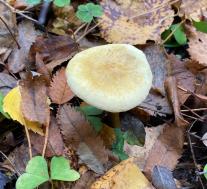
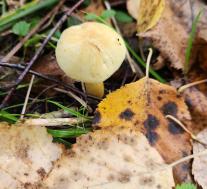
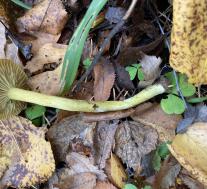
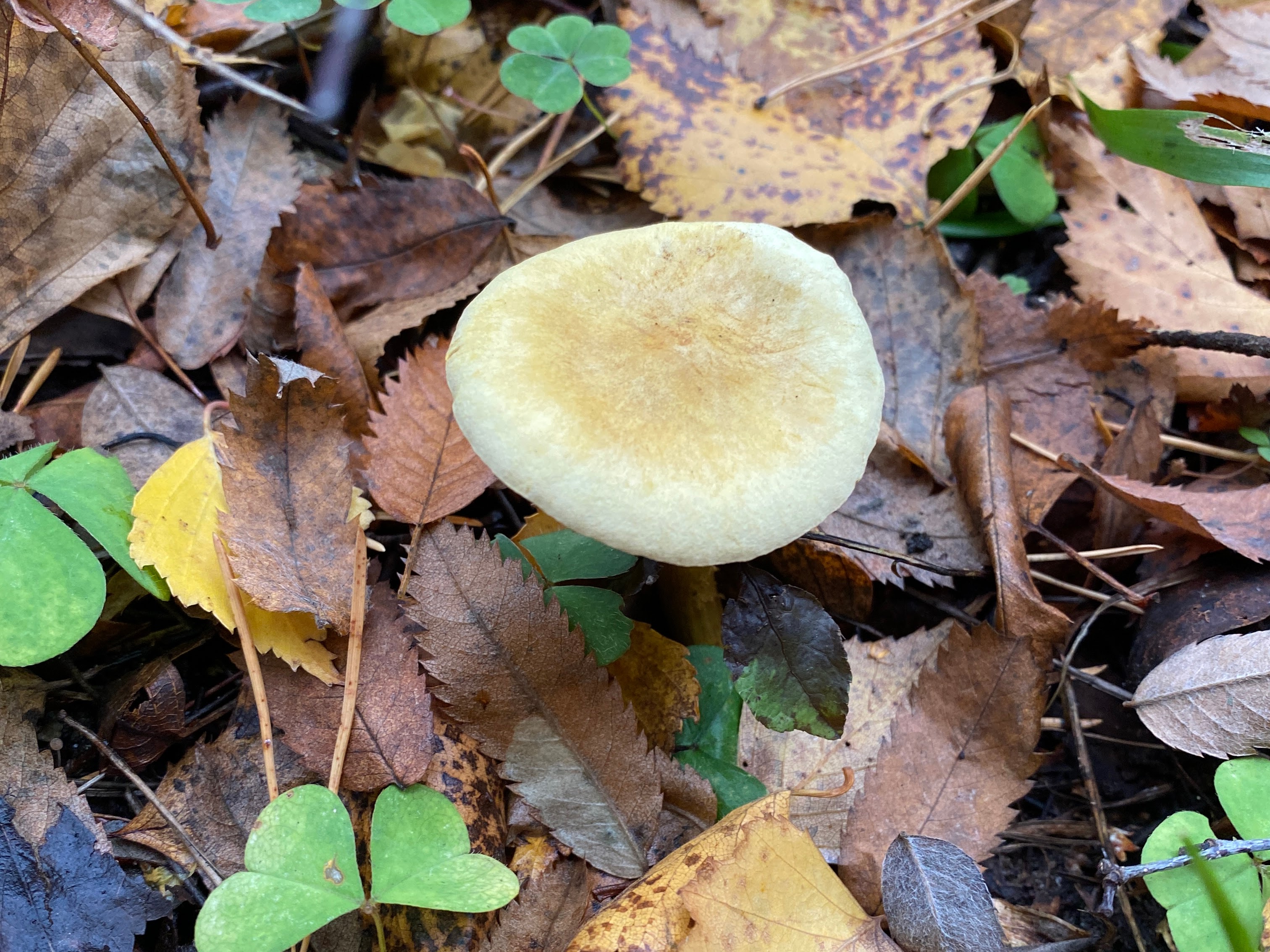
2.5–10 cm in diameter; initially conical, bell-shaped, or convex, expanding at maturity to flattened with a broad central umbo or without one, often becoming concave with a wavy, lobed margin with age. Surface smooth or very finely velvety, sulphur-yellow, yellowish-green, generally slightly darker toward the center. Hymenophore lamellate. Gills adnate, broad, not crowded; sulphur-yellow, lemon-yellow, or yellowish-green.
3–11 cm long, 0.5–2.5 cm in diameter, cylindrical, smooth, concolorous with the cap, with a white bloom and yellow mycelium at the base. Surface initially smooth, becoming rougher with age, turning fibrous-scaly.
Flesh dense, sulphur-yellow, lemon-yellow, or pale yellow, sometimes olive-green at the base of the stipe. Taste bitter, floury-rancid.
Unpleasant, chemical, strong and pungent; however, in young mushrooms, fragrant, floral notes may predominate in the odor.
Spore print: white. Spores ellipsoid, often slightly fusiform or almond-shaped.
Произрастает обычно группами в лиственных и смешанных лесах, предпочитает богатые известью почвы. Образует микоризу с дубом и буком, реже — с сосной и пихтой. Иногда встречается на обочинах дорог на песчаных почвах. Широко распространена по всей Европе — от холодных арктических зон до Средиземноморья.
Not listed in the Red Data Books of the Russian Federation or its regions. However, it is under threat of extinction in Turkey.
Plums and custard (Tricholomopsis rutilans) is perhaps the most striking representative of the genus Tricholomopsis. Yellow gills and purplish-red scales on the cap and stipe allow reliable identification of this species in the field. Yellow knight (Tricholoma equestre) is dominated by green tones in its coloration and has a pleasant, mushroom-like odor. In principle, all knights with similar color schemes can be confused with one another. Therefore, we do not recommend enthusiastic collecting of such mushrooms without sufficient knowledge of their identification.
It is now known that the sulphur knight (*Tricholoma sulphureum*) represents a complex of cryptic species that have yet to be distinguished.
Add new comment