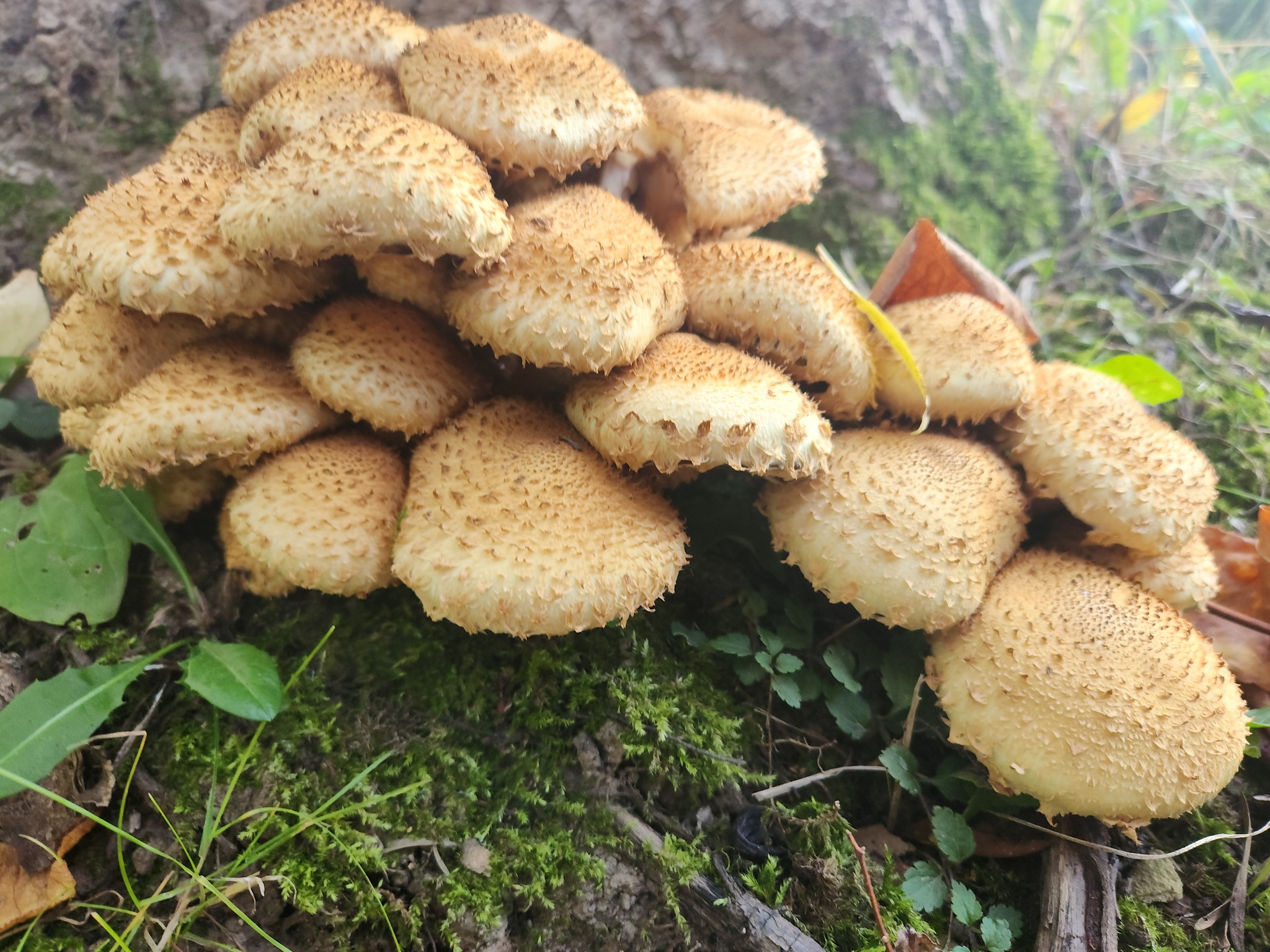
Common Pholiota, Shaggy Scalycap (Pholiota squarrosa)
Чешуйчатка обыкновенная
Current name

Index Fungorum   Pholiota squarrosa (Vahl) P. Kumm. 

MycoBank   Pholiota squarrosa (Vahl) P. Kumm. 

Other names

Scaly Pholiota, Destructive Pholiota, Hairy Pholiota.

Systematic position
Specific epithet etymology

Squarrosus, a, um — covered with scabs, scales, rough.

Synonyms

Dryophila squarrosa (Vahl) Quél., Enchiridion Fungorum in Europa media et praesertim in Gallia Vigentium: 68 (1886) 

Lepiota squarrosa (Vahl) Gray, A natural arrangement of British plants 1: 602 (1821)

Stropharia squarrosa (Vahl) Morgan, Journal of Mycology 14 (2): 73 (1908)

Fungus squarrosus (Vahl) Kuntze, Revisio generum plantarum 3 (3): 479 (1898)

Pholiota squarrosa f. squarrosa (?)
Habit
Fruiting body
Agaricoid (cap and stipe)
Hymenophore
Lamellate (gills present, including folded or rudimentary)
Fruiting period (list)
JunJune (1st–10th)June (11th–20th)June (21st–30th)JulJuly (1st–10th)July (11th–20th)July (21st–31st)AugAugust (1st–10th)August (11th–20th)August (21st–31st)SepSeptember (1st–10th)September (11th–20th)September (21st–30th)
Mushroom cap

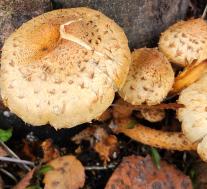
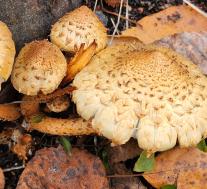
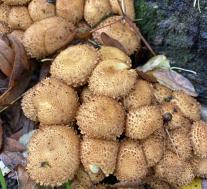
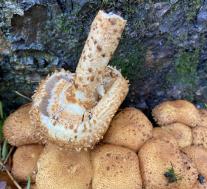
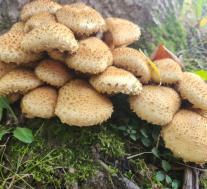
3–15 cm in diameter, initially convex or bell-shaped with an inrolled margin, expanding at maturity to plano-convex or flat, with or without a central umbo. The surface is dry, ranging from pale yellow to golden yellow, entirely covered with woolly, pointed, reddish-brown scales. The margin bears fringed remnants of the partial veil.

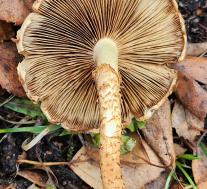
Gills narrowly adnate or adnexed with a tooth, initially pale yellow, later rusty brown, sometimes with an olive tint; in young fruiting bodies, they are covered by a membranous-fibrous partial veil.

Stem

5–15 cm long, 1–2 cm in diameter, tapering toward the base, firm, curved, sometimes deeply rooted in the substrate, with a woolly or floccose ring in the upper part. The surface is pale yellow, with a white bloom above the ring and covered with reddish-brown scales below the ring.

Flesh

Elastic, thick, fleshy. In the cap pale yellow, with a greenish zone at the point of gill attachment; in the stipe yellow. Taste unpleasant, rancid.

Odor

Weak, pleasant mushroom-like. With age, the odor becomes unpleasant.

Microscopy

Spore print ochraceous. Spores ellipsoid, with a discernible germ pore, smooth, pale yellow.

Ecology and distribution

Xylotroph. Parasite. Grows in numerous clusters at the base of tree trunks, primarily on deciduous species (Fagus, Salix, Fraxinus, Malus, Betula, Populus, and others), occasionally found on conifers (Picea). Distributed in Europe, Asia, North America, and Japan. Common, annual. The fungus is capable of continuing its development on dead trees, forming fruiting bodies annually until the complete decomposition of the wood.

Fruiting

June–September.

Nutritional properties
Poisonous

Ph. squarrosa достаточно давно не считается съедобным грибом. Несмотря на то, что некоторые люди употребляют его без видимого негативного эффекта, для других всё может оказаться более плачевно. Исследования не выявили в грибе токсинов, которые напрямую влияют на организм. Но были обнаружены лектины, которые не разрушаются в средах с разной кислотностью (pH от 2 до 11) и при термической обработке (выдерживают до 100 °С). Одни лектины ингибируют эритроциты в организме человека, другие вызывают желудочно-кишечные расстройства.

Similar species

Scaly Pholiota (Pholiota squarrosoides) — macroscopically can be distinguished from Ph. squarrosa by the lighter, almost white, sticky, slightly slimy surface of the cap between the scales; microscopically — by smaller spores.

It is dangerous to confuse Ph. squarrosa with autumn honey fungi, representatives of the genus Armillaria, which grow in large clusters at the base of tree trunks. They are easily distinguished by their smaller size and white spore print. At the same time, one of the folk names for Pholiota is "royal honey mushroom".

Notes

Common Scaly Pholiota is a potential source for the production of medicinal compounds. In 2007, Wangun H. V. K. and Hertweck C. isolated a new substance from it named squarrosidine, which inhibits the enzyme xanthine oxidase. Xanthine oxidase promotes the crystallization of uric acid in joints, leading to gouty arthritis, and inhibitors of this enzyme are used to treat gout.

Link to this page for printed editions
Shipovalov A.G. Common Pholiota, Shaggy Scalycap (Pholiota squarrosa) - Mushrooms of Vologda Region [Electronic resource] URL: https://xn----7sbancweblffgklubds60aja.xn--p1ai/en/common-pholiota-shaggy-scalycap-pholiota-squarrosa (accessed: 13.04.2026).
Share link

Add new comment

One file only.
2 MB limit.
Allowed types: png jpeg jpg jpe gif webp svg.
Allowed types: png gif jpg jpeg webp svg.

Plain text

  • No HTML tags allowed.
  • Lines and paragraphs break automatically.
  • Web page addresses and email addresses turn into links automatically.
Add image
Maximum 8 files.
2 MB limit.
Allowed types: png jpeg jpg jpe gif webp svg.
Allowed types: png gif jpg jpeg webp.
January (1st–10th)
January (1st–10th)
January (11th–20th)
January (11th–20th)
January (21st–31st)
January (21st–31st)
February (1st–10th)
February (1st–10th)
February (11th–20th)
February (21st–28th/29th)
March (1st–10th)
March (1st–10th)
March (11th–20th)
March (11th–20th)
March (21st–31st)
March (21st–31st)
April (1st–10th)
April (1st–10th)
April (11th–20th)
April (11th–20th)
April (21st–30th)
April (21st–30th)
May (1st–10th)
May (1st–10th)
May (11th–20th)
May (11th–20th)
May (21st–31st)
May (21st–31st)
June (1st–10th)
June (1st–10th)
June (11th–20th)
June (11th–20th)
June (21st–30th)
June (21st–30th)
July (1st–10th)
July (1st–10th)
July (11th–20th)
July (11th–20th)
July (21st–31st)
July (21st–31st)
August (1st–10th)
August (1st–10th)
August (11th–20th)
August (11th–20th)
August (21st–31st)
August (21st–31st)
September (1st–10th)
September (11th–20th)
September (21st–30th)
October (1st–10th)
October (1st–10th)
October (11th–20th)
October (11th–20th)
October (21st–31st)
October (21st–31st)
November (1st–10th)
November (1st–10th)
November (11th–20th)
November (21st–30th)
December (1st–10th)
December (1st–10th)
December (11th–20th)
December (21st–31st)