Luminous Pholiota (Pholiota lucifera)
Index Fungorum Pholiota lucifera (Lasch) Quél
MycoBank Pholiota lucifera (Lasch) Quél
Luminous Champignon
lucifer, fera, ferum, light-bearing
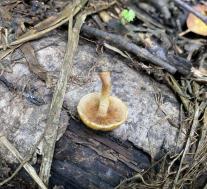
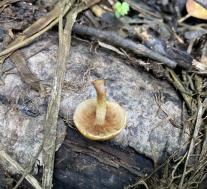
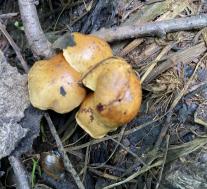
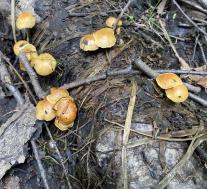
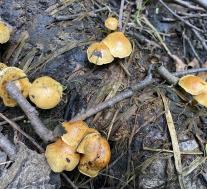
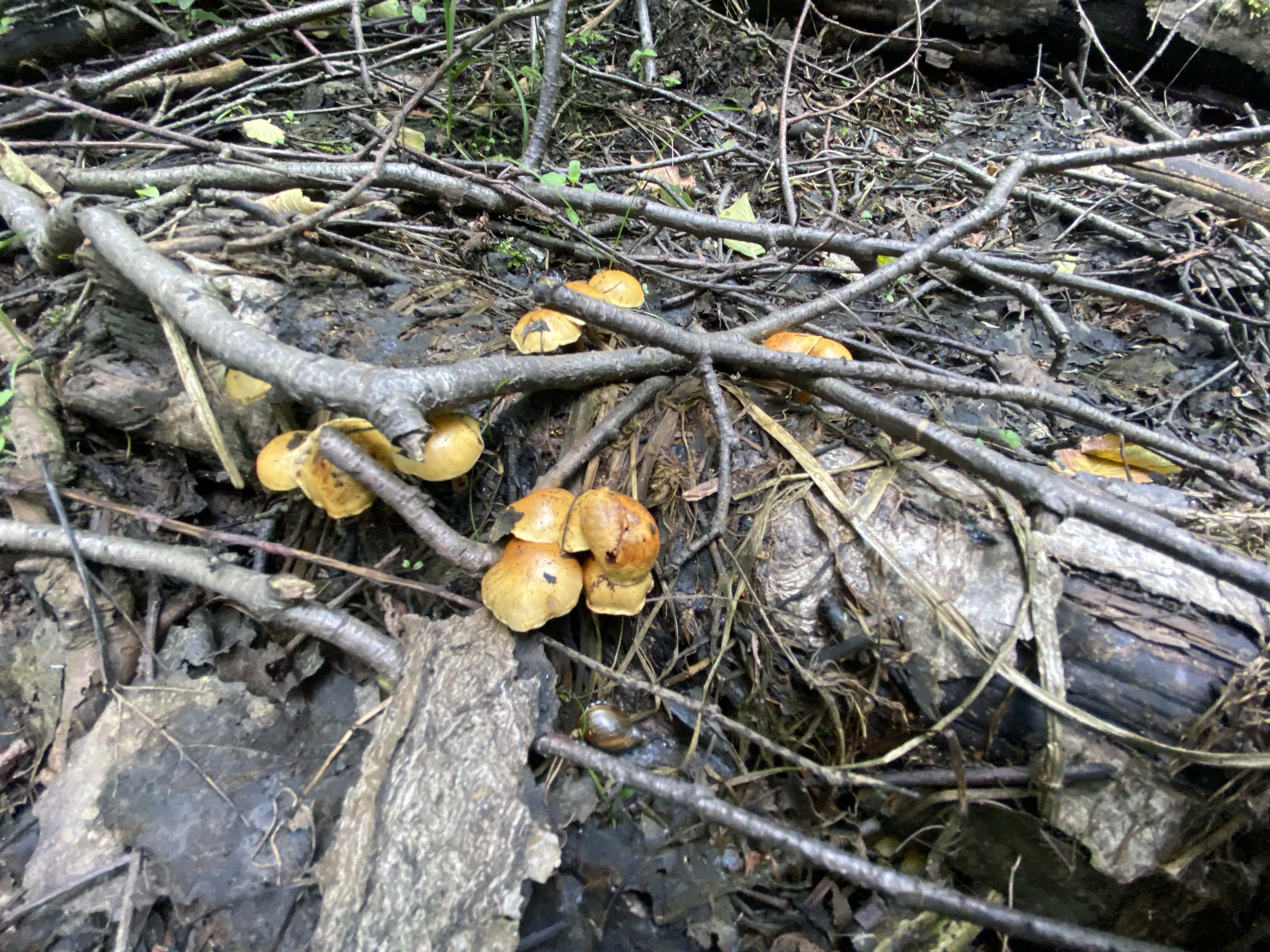
Up to 6 cm in diameter. Yellow-golden, lemon-yellow, sometimes with a darker, reddish-brown central part. In youth hemispherical, convex, then plano-convex, expanded, with a downturned margin. The cap of the young mushroom is covered with well-distinguishable, sparse, elongated, flat rust-colored scales. With age, the scales fall off or are washed away by rain, and the cap remains practically smooth, reddish in color. The cuticle on the cap is sticky, viscid. Along the lower edge of the cap are remnants of the partial veil, hanging as a tattered fringe.
1–5 cm long and 0.3–0.8 cm thick. Solid. Even, may be slightly thickened at the base. Remnants of the partial veil are always present in the form of a conditionally expressed ring. Above the ring the stem is smooth, light, yellowish. Below the ring—same color as the cap, covered with a fluffy, soft scaly covering, sometimes very well pronounced. With age this covering darkens, changing color from yellow-golden to rust.
Light, white or yellowish, may be darker closer to the stem base. Dense. Taste bitter.
Weakly distinguishable.
Spore print brown. Spores ellipsoid or bean-shaped, smooth.
Xylotroph. Parasite. Widespread in Europe. Grows in forests of any type, can grow in open areas; on leaf litter or on decaying wood buried in the ground.
The mushroom is listed in the Red Data Book of Bulgaria with the status "endangered".
Scaly Pholiota Pholiota tuberculosa is a very similar species, but Pholiota lucifera differs by its slightly gelatinized pileipellis. Luminous Pholiota is often confused with autumn honey fungi, representatives of the genus Armillaria, which grow in large clusters at the base of tree trunks. They are easily distinguished by their smaller size and white spore print.
Due to its rare occurrence and similarity to other small Pholiota species, it is difficult to accurately assess the range of this species, but it can still be assumed that this is a more southern species gradually expanding its range northward.
Add new comment