Fragile Cystoderma (Cystoderma amianthinum)
Index Fungorum Cystoderma amianthinum (Scop.) Fayod
MycoBank Cystoderma amianthinum (Scop.) Fayod
Amianthine Parasol, spiny Cystoderma.
*Amianthinus, a, um* (mycol.) — unstained, pure, unblemished.
Lepiota amianthina (Scop.) P. Karst., Bidrag Kännedom Finlands Natur Folk 32: 15 (1879)
Lepiota granulosa var. amianthina (Scop.) P. Kumm., Der Führer in die Pilzkunde: 136 (1871)
Armillaria amianthina (Scop.) Kauffman, Pap. Michigan Acad. Sci. 2: 60 (1923)
Agaricus granulosus var. amianthinus (Scop.) Fr., Epicrisis Systematis Mycologici: 18 (1838)
Agaricus granulosus subsp. amianthinus (Scop.) Romell, Sv. Fl. Skol., Krypt. ed. 2: 160 (1898)
Lepiota granulosa subsp. amianthina (Scop.) S. Lundell, Sv. Fl. Skol., Krypt. ed. 5: 205 (1932)
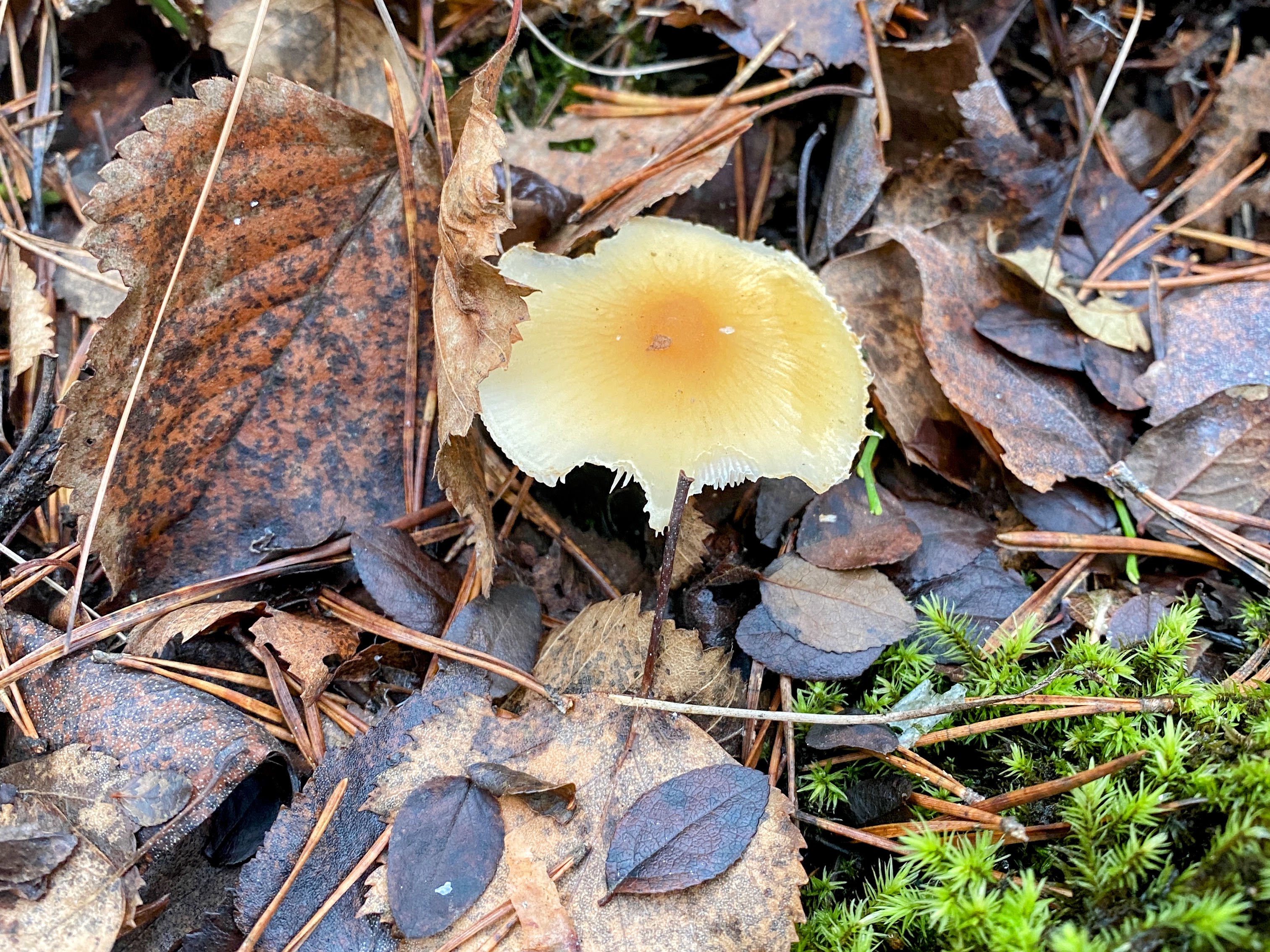
The Fragile Cystoderma lives up to its somewhat obscure name. At first glance, "amianthinum" doesn't seem to mean much (and honestly, it doesn't), but once you've learned it, you're unlikely to forget it. Though, to be fair, there's no particular reason for anyone to remember this mushroom in the first place.
Cap 1.5–5 cm in diameter, initially conical, expanding with maturity to convex or broadly spread, with a blunt umbo (central bump). The margin is fringed, bearing light, floccose remnants of the partial veil; initially curved inward, then straightening out, and sometimes turning upward in old specimens. Color ranges from brownish-yellow to yellow-orange, slightly darker toward the center. The surface is granular-mealy, covered with fine granules, and radially or net-like wrinkled.
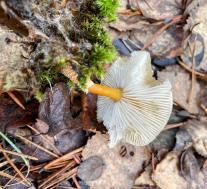
Gills are adnate (attached to the stipe), crowded, initially white, later becoming cream or yellowish. In young mushrooms, they are covered by a yellowish, fibrous partial veil.
3–6 cm long and 0.3–0.7 cm in diameter, cylindrical, solid when young, becoming hollow with age, with a ring, and matching the cap in color. The surface is longitudinally fibrous with whitish veins; smooth above the ring, and covered with soft, floccose scales below it. The ring detaches easily from the stipe and is often absent.
Orange-yellow, watery. Taste is mild, without any distinctive features.
Musty, unpleasant.
Spore print: white. Spores are ellipsoid, smooth, and hyaline.
Widely distributed across the Northern Hemisphere. Found in mossy forests, heathlands, and among grass and moss. Grows singly or in small groups, primarily in coniferous forests, less commonly in mixed forests. Often occurs on acidic soils.
Jason's Cystoderma (Cystoderma jasonis) was once treated as two varieties of the Fragile Cystoderma — Cystoderma amianthinum var. longisporum and var. sublongisporum. It was described as a distinct species in 1978. It can be reliably distinguished under the microscope by its longer spores. External differences are more subtle: the granules on the cap surface are darker, and the upper part may show purplish tones.
Cinnabar Cystodermella (Cystodermella cinnabarina) is a related species that was relatively recently moved to its own genus, Cystodermella. It differs from C. amianthinum by its bright orange-red cap lacking radial wrinkles, and by its overall more robust appearance, with a relatively short, thick stipe and a fleshy cap.
This species is often parasitized by a mycophilic fungus — the Paradoxical Squamanita (*Squamanita paradoxa*), which was formerly placed in the genus *Cystoderma* before being moved to the genus *Squamanita*, which later became the type genus of its own family. It resembles *Cystoderma* in general appearance but is paler, with grayish tones. It develops on deformed fruiting bodies of *C. amianthinum*, which take on the form of a columnar, sterile sclerotium, from whose apex the fruiting body of *Squamanita* emerges. It is also inedible.
The cap and upper part of the stipe of the parasitized *Cystoderma* take on purplish hues, while the lower part of the stipe remains unchanged, creating an interesting color contrast.
Add new comment