Granular Cystoderma (Cystoderma granosum)
Index Fungorum Cystoderma granosum (Morgan) A.H. Sm. & Singer
MycoBank Cystoderma granosum (Morgan) A.H. Sm. & Singer
Granular Agaricus, granular Lepiota.
granulōsus, a, um мик. 1) granulated; 2) having a well-defined granular structure, granular + -ōsus.
Agaricus granosus Morgan, J. Cincinnati Soc. Nat. Hist. 6: 63 (1883)
Lepiota granosa (Morgan) Sacc., Syll. fung. (Abellini) 5: 48 (1887)
Mastocephalus granosus (Morgan) Kuntze, Revis. gen. pl. (Leipzig) 2: 860 (1891)
Information about edibility is contradictory. In Russian-language sources, the mushroom is listed as edible but of low culinary value; in Western literature, it is usually noted as poisonous. Most authors agree that the species resembles some poisonous webcaps (Cortinarius) and parasols (Lepiota), so consuming it is a bad idea.
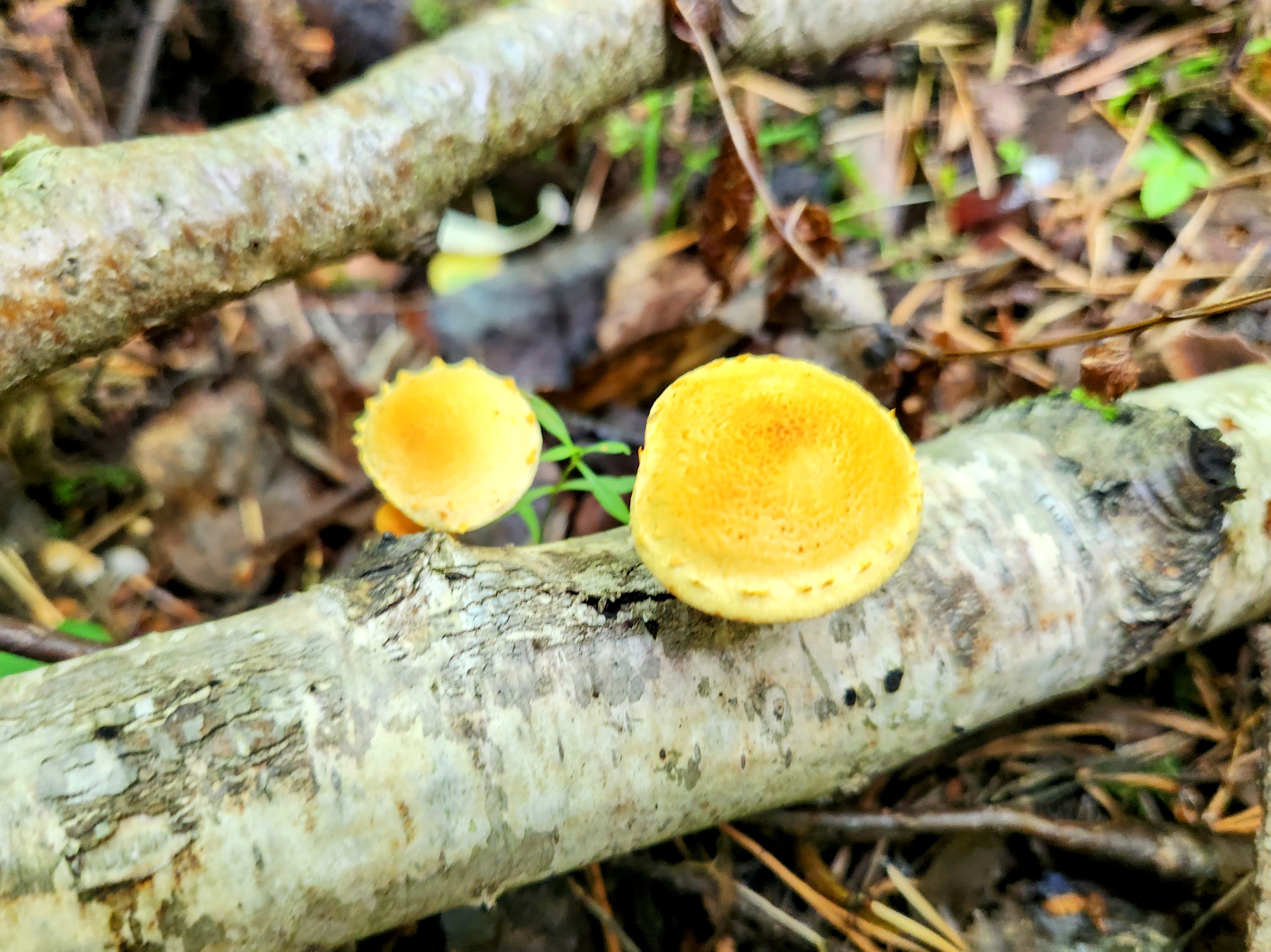
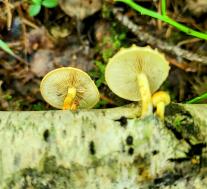
1–5 cm in diameter; in young mushrooms — ovoid, convex, with an incurved margin, covered with flakes and "warts", with a fringed margin; in mature mushrooms — plano-convex or spreading; cap cuticle dry, finely granular, sometimes wrinkled, reddish-brown or ochre-brown, sometimes with an orange tint, fading.
Gills weakly adnate, crowded, with intermediate lamellulae, creamy or yellowish-white.
2–6 cm long and 0.5–1 cm in diameter, cylindrical or expanding toward the base, hollow, dry, concolorous with the cap or lilac-tinted; above the ring zone — smooth, lighter, below the ring zone — granular, with scales. A true ring is absent.
Whitish or yellowish, watery, with an indistinct taste.
Weak, mushroom-like.
Spore print white. Spores small, egg-shaped, with smooth walls.
Widely distributed in Europe and North America. Grows scattered or in groups on decaying hardwood. Despite its wide range, the mushroom is quite rare.
Granular Cystoderma is very similar to the edible cinnabar-red Cystoderma (Cystoderma terrei), which can be recognized by the cinnabar-red or orange coloration of the cap and the scales on the stipe.
Add new comment