Pholiota populnea (Destructive pholiota)
Index Fungorum Pholiota populnea (Pers.) Kuyper & Tjall.-Beuk.
MycoBank Hemipholiota populnea (Pers.) Bon
Hemipholiota populnea
Populneus, a, um poplar trees. From pupulus — poplar + -eus, a, um quality.
Agaricus populneus Pers., Mycologia Europaea (Erlanga) 3: 171 (1828) - Basionym
Hemipholiota populnea (Pers.) Bon, Docums Mycol. 17(no. 65): 52 (1986)
Agaricus destruens Brond., Rec. Pl. Crypt. Agenais (Agen) 2: 20 (1829) [1828-1830]
Pholiota destruens (Brond.) Gillet, Les Hyménomycètes ou Description de tous les Champignons (Fungi) qui Croissent en France avec l'indication de leurs propriétés utiles ou vénéneuses (Alençon): 442 (1876) [1878]
Dryophila destruens (Brond.) Quél., Enchiridion Fungorum in Europa media et praesertim in Gallia Vigentium: 67 (1886)
Agaricus comosus Fr., Epicrisis Systematis Mycologici: 165 (1838) [1836-1838]
Pholiota comosa (Fr.) Quél., Mém. Soc. Émul. Montbéliard, Sér. 2 5: 125 (1872)
Hemipholiota comosa (Fr.) Bon, Z. Mykol. 60(1): 71 (1994)
Pholiota comosa var. alba Peck, Ann. Rep. N.Y. St. Mus. nat. Hist. 38: 86 (1885)
Agaricus comosus var. albus Peck, Ann. Rep. N.Y. St. Mus. nat. Hist. 38: 86 (1885)
Pholiota destruens var. edmundii A.H. Sm. & Hesler, The North American species of Pholiota: 125 (1968)
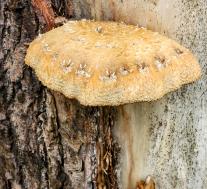
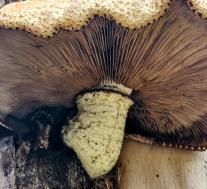
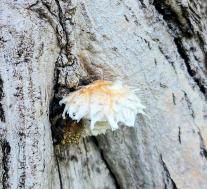
In the course of scientific research, the fungus was found to have antifungal and cytotoxic activity against certain cancer cell lines. For the first time, four lanostane derivatives, a triterpene tetraol, ergosane derivatives, and two nucleosides were isolated from Hemipholiota populnea. The triterpenes demonstrated cytotoxic activity against the Colo 205 and Colo 320 cell lines, and the triterpene tetraol exhibited strong synergism with the anthracycline antibiotic doxorubicin.
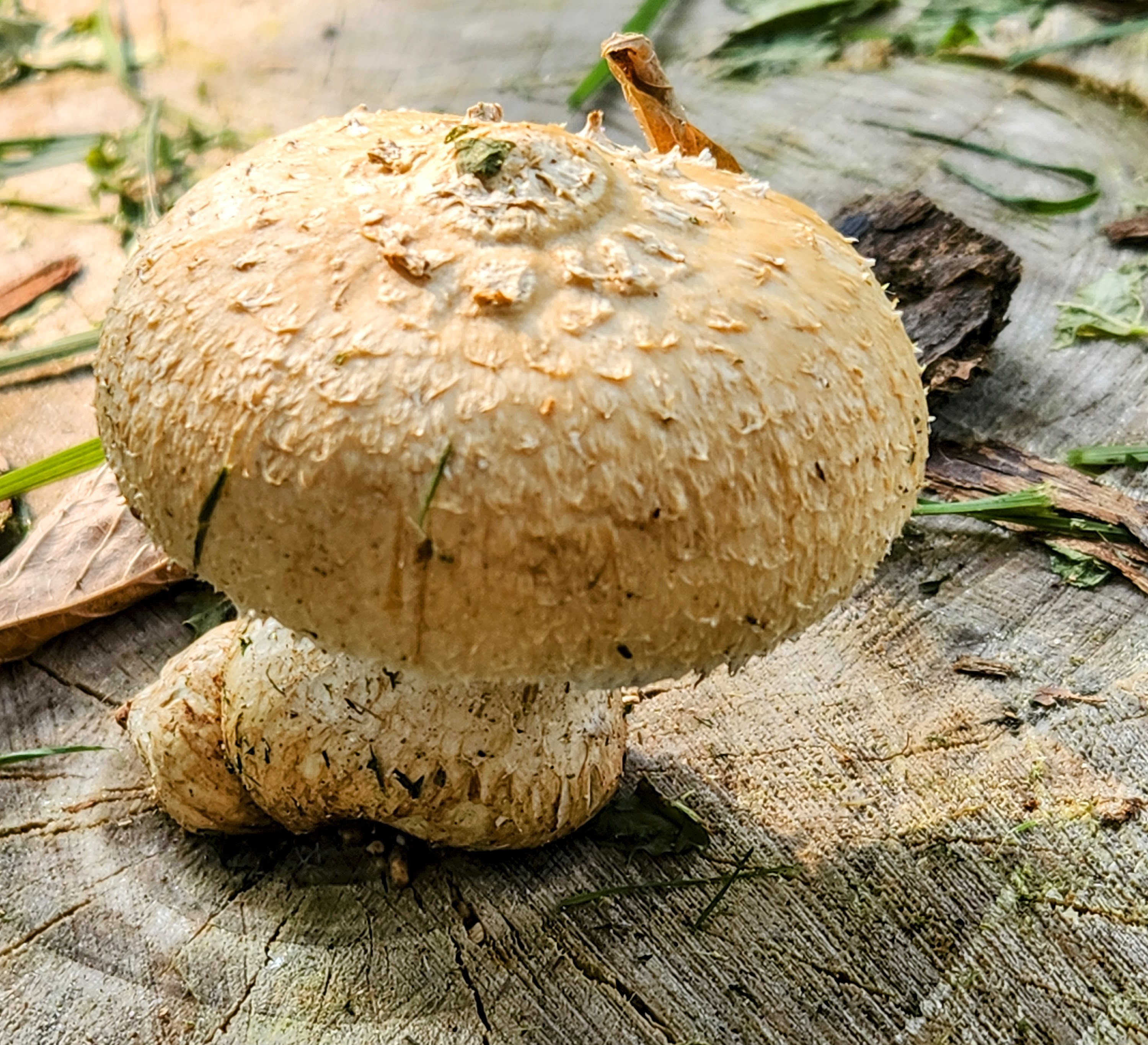
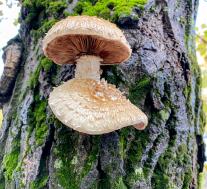
The cap (6) is 8-16 (20) cm in diameter, initially hemispherical with a rolled-up edge, then opens up to a flat cap with a bump in the center. The surface is viscous and sticky, with large white fibrous scales that may disappear over time. The cap color of young fruit bodies is white or yellowish-white, but it darkens to red-yellow or brown as it matures.
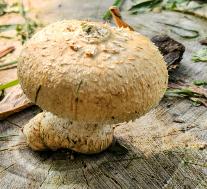
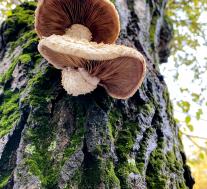
The gills are attached to the stem, wide, grayish-white, and darken to brown in mature specimens. In immature specimens, the gills are covered with a white, felt-like private veil.
The stem is central or eccentric, 5-12 (18) cm long, 1-3 cm in diameter, curved, thickening towards the bottom, and rigid. Young fruiting bodies have a white or beige stem with large white scales and a flaky ring, which then darkens from the base, where it can become almost black with age, and the scales and ring become less visible or disappear.
It is dense, ranging from whitish in the cap to yellow-brown at the base of the stem. It does not change color when broken. The taste is unpleasant, bitter, and sour.
Weak, unpleasantly sour.
Spore print: brownish-red. Spores 7–9 x 4–5 μm; ellipsoid; smooth; thick-walled; pale brown in KOH.
It grows on live and dead wood of deciduous trees, preferring poplar (Populus). It is very widespread.
Status 3. A species with a decreasing number and limited distribution in the Ulyanovsk region.
Limiting factors:
Recreational loads, intensive exploitation of forests.
Hemipholiota heteroclita is characterized by a lighter color of the cap (light yellow, yellow-ochre) and a pleasant fruity smell of the pulp. It is more often confined to Betula wood.
Add new comment