Northern Honey Fungus (Armillaria borealis)
Index Fungorum Armillaria borealis Marxm. & Korhonen
MycoBank Armillaria borealis Marxm. & Korhonen
Northern Honey Fungus.
Borealis, e — northern. From Boreas, ae m. the north wind + -alis, e, denoting quality.
Studies of fruiting bodies across various regions have shown that intraspecific variation of traits can exceed interspecific variation.
Amateur identification of honey mushrooms based on macroscopic features is largely a misleading practice.
American mycologist Tom Volk called the genus Armillaria "the shame and curse of modern mycology."
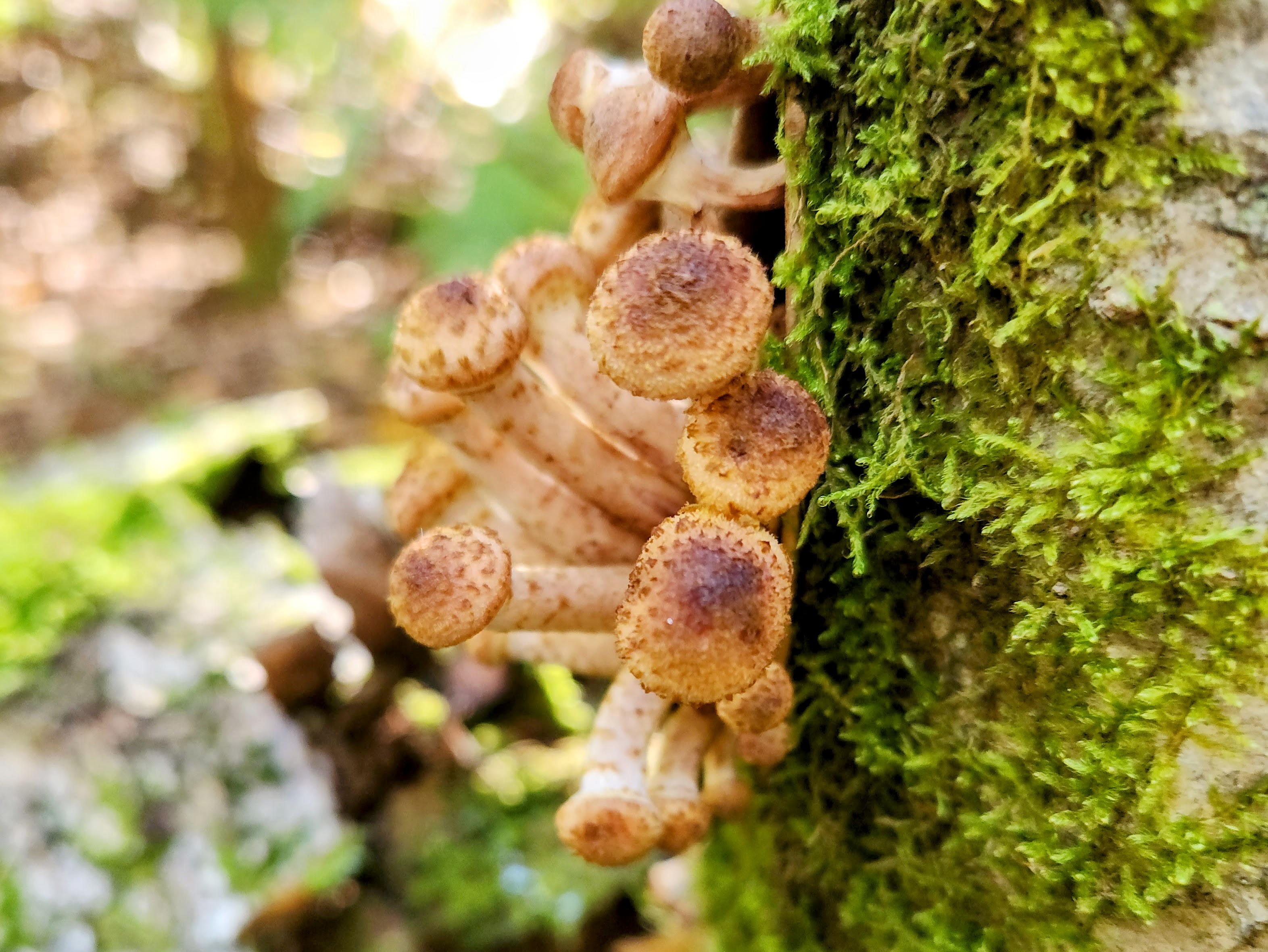
2–12 cm in diameter; coloration ranging from yellowish-brown to bright ochre or orange-brown, often with an olive tint and a distinctive olive-honey hue on the disc. The center of the cap is generally less intensely colored, sometimes becoming golden-yellow, but without lemon nuances; toward the margin, the coloration becomes dirty dark yellow. Margin translucent-striate, slightly woolly. Scales small, matching the cap color or slightly darker: yellowish-cream, ochre, brown, or olive to dark brown, more numerous toward the center of the cap. Gills slightly decurrent, white at first, then becoming ochre-cream.
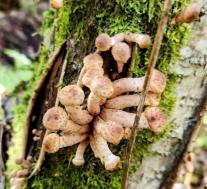
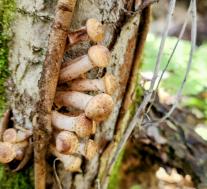
Up to 10 × 1.5 cm in size, thin, cylindrical, sometimes slightly club-shaped and expanding toward the base, reaching 2 cm at the base. Stipe color ranging from ochre to brownish at the bottom, with yellowish-white pubescence or fibers; in the upper part with a light, easily wiped-off coating from spore powder. Below the ring, the stipe is covered with sparse floccose, whitish, yellowish, or yellow-brown, fluffy-felted scales, arranged irregularly.
Ring well-developed, thick, initially fibrous-cottony, then resembling a thick film or almost membranous; usually simple or double, from white or whitish to cream, becoming beige or brown with age. On the underside of the ring, a necklace of yellow or ochre fluffy-felted scales, which become dark brown with age.
Flesh in the cap and upper part of the stipe dense, beige, white below, resembling dense cotton; the stipe surface is firmer, forming a characteristic dark ring around the lighter flesh when cut.
Mushroom-like, pleasant.
Spore print white. Spores 7–8 × 4.5–5.5 µm, medium-sized, relatively elongated, nearly tear-shaped.
Fruiting bodies grow in clusters, large groups, and are found on various trees, both deciduous and coniferous.
All honey mushrooms of the genus Armillaria are very similar to each other.
Honey Fungus (Armillaria mellea) grows in the southern and extreme western regions of our country.
Northern Honey Fungus (Armillaria borealis) has a more pronounced and durable veil that always remains as a ring on the stipe. Northern Honey Fungus grows in large clusters.
Inexperienced foragers may also confuse honey mushrooms with various Pholiota species, which are distinguished by more pronounced scales and a bitter taste.
Possesses bioluminescent properties.
Add new comment