Tricholoma apium
Index Fungorum Tricholoma apium Jul. Schäff.
MycoBank Tricholoma apium Jul. Schäff.
Apium, i n., celery.
Tricholoma helviodor Pilát & Svrček, Stud. Bot. Čechoslov. 7: 2 (1946)
Tricholoma apium var. helviodor (Pilát & Svrček) M.M. Moser, in Gams, Kl. Krypt.-Fl., Edn 4 (Stuttgart) 2b/2: 120 (1978)
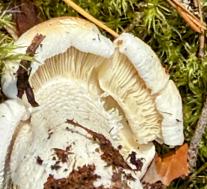
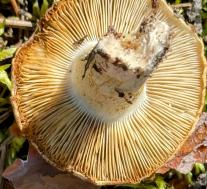
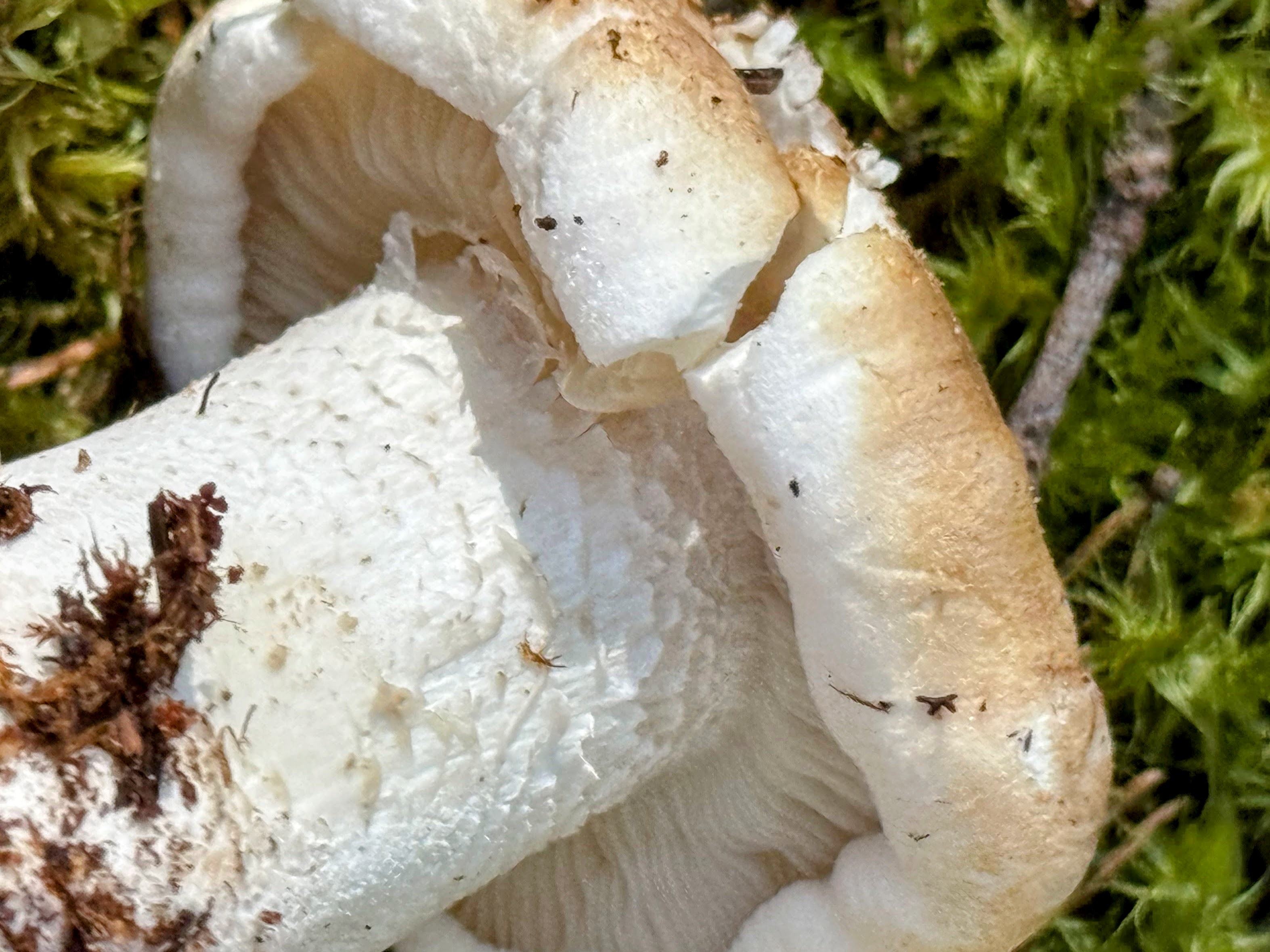
Up to 15 cm in diameter, dry, slightly felty, unevenly colored in whitish-cream, brownish-cream, and brownish tones, often with an olive tint. Smooth and light when young, darkening with age, usually becoming finely tuberculate, granular-scaly, or finely fissured. The cap of young mushrooms, hidden in the litter, is almost white, sometimes with yellowish spots and grooves. With age, it becomes a fairly bright mustard color with brown, golden, and olive hues; sometimes darker in the center. The color intensity is related to exposure to sunlight, and where fragments of litter adhere to the cap, it remains light.
Gills are free or semi-adherent, close or very close together, white, beige, or yellowish, fairly firm to the touch; With age, they may become covered with small reddish spots.
Cylindrical, up to 70 mm long and up to 30 mm in diameter, tapering slightly toward the base, white, turning brownish with age. Covered with scales of the same color or slightly darker, small, scattered, or forming an unclear moiré pattern.
Dense, white. The taste is soft, floury or slightly spicy.
Sweet and spicy, with a slight floury note. The unique aroma of this species is reflected in one of the synonyms of the species name: T. helviodor, meaning "a milkweed with a scent like that of the milkweed Lactarius hevus." This milkweed's aroma is certainly distinctive and "delicious," but less spicy and sweeter than that of the celery milkweed.
The spore powder is white. Spores are 3.4–5.6 × 2.9–4.6 µm, smooth, generally colorless, and predominantly broadly ellipsoidal (Qav = 1.21–1.33).
Stenotop. Grows on the soil in small groups, rarely solitary. It forms mycorrhiza with Scots pine (Pinus sylvestris), is confined to clean, dry pine forests with white mosses on poor, sandy soils, and is sensitive to overfertilization and soil pollution with nitrogen compounds.
A rare, little-known species. It is widespread throughout the boreal zone, but in North America, the population is apparently significantly smaller than in Eurasia. In Eurasia, the known population is concentrated in Fennoscandia, and the number of records in mainland Europe is very small. This information, however, does not take into account data from the boreal zone of Russia and Siberia in particular, where habitats suitable for T. apium are still very widespread.
Status: Vulnerable. Limiting factors: threat of destruction of suitable habitats and associated negative population dynamics.
Status 3. Category (NT); conservation priority. Limiting factors: the species' demand for a specific combination of environmental conditions—its association with oligotrophic habitats. Threats include deforestation, alteration of the natural development of forest communities through forestry or recreational activities, and habitat eutrophication.
Tricholoma arvernense is a little-known Tricholoma species with a similar habit and similar ecological preferences. It is distinguished by a generally longer stem and a radially fibrous, rather than velvety, matte cap with a less saturated coloration—young fruiting bodies are yellowish-olive, later fading to a brownish-gray. The flesh of this Tricholoma is less dense and more fibrous, with a sharp, floury odor.
Add new comment