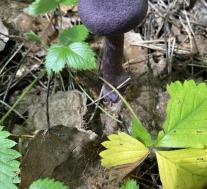
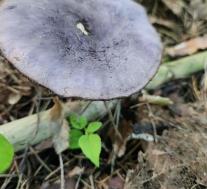
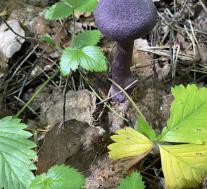
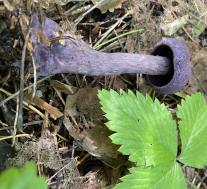
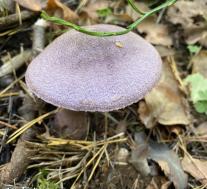
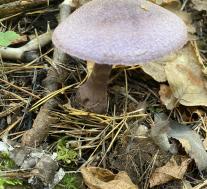
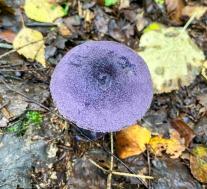
Violet Webcap (Cortinarius violaceus)
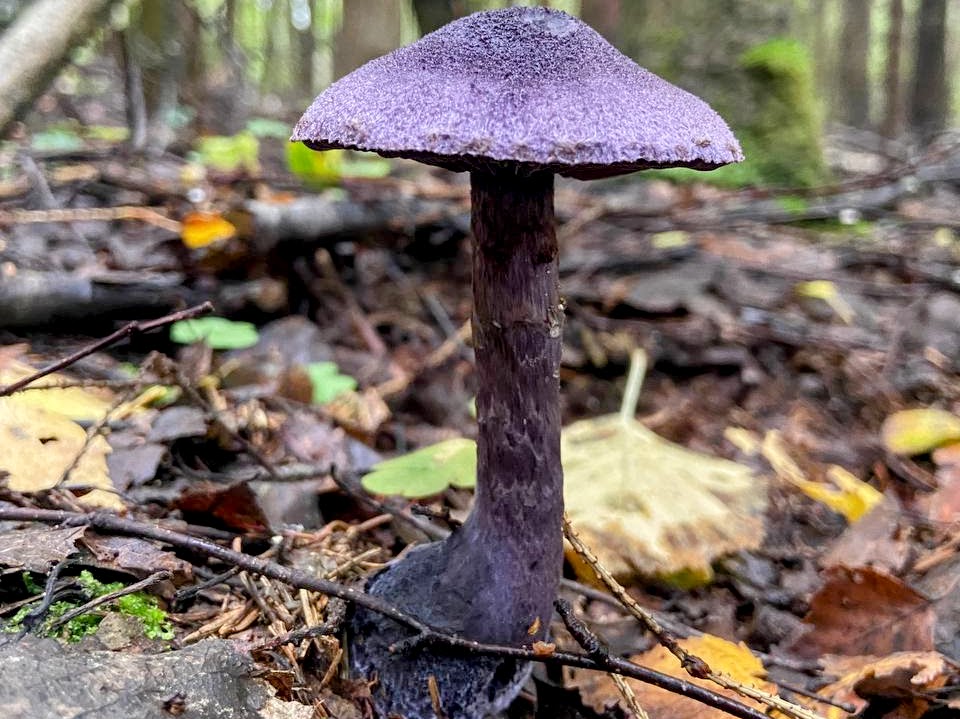
Паутинник фиолетовый
Current name

Index Fungorum Cortinarius violaceus (L.) Gray 

MycoBank Cortinarius violaceus (L.) Gray

Other names

Marsh dweller, the stout one.

These are Russian vernacular names for the species. In English, it is commonly known as the violet webcap.
Systematic position
General description

A fairly rare mushroom; until May 2023, it was listed in the Red Data Book of the Russian Federation. It has since been removed from the federal list but remains included in many regional Red Data Books.

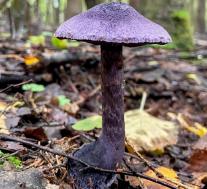
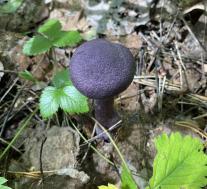
The species name describes it perfectly: it's a webcap, and it's violet. Knowing these two features allows you to identify it to species level in the field with confidence. All webcaps have a cobweb-like partial veil (the cortina), made of interwoven fibers that protect the spores as they mature. Over time, this veil tears and disappears, sometimes leaving only small fragments on the cap — and not always even that.

Many webcap species are poisonous, and very few are edible. The ability to identify them to species is considered a distinct skill among mycologists. So we don't recommend getting too adventurous with culinary experiments in this group!

Habit
Fruiting body
Agaricoid (cap and stipe)
Hymenophore
Lamellate (gills present, including folded or rudimentary)
Fruiting period (list)
JulJuly (1st–10th)July (11th–20th)July (21st–31st)AugAugust (1st–10th)August (11th–20th)August (21st–31st)SepSeptember (1st–10th)September (11th–20th)September (21st–30th)
Mushroom cap

Cap 4–15 cm in diameter. When young, spherical or convex; later becoming flat to broadly spread, with the margin curved inward. The cap surface is finely scaly and woolly-felted. Dark violet.

Stem

5–13 cm long and 1–3 cm in diameter, cylindrical or slightly widening toward the base. Fibrous in texture. The upper part is covered with fine scales. The base has a tuberous thickening. Brown or dark violet.

Flesh

Juicy, dense. Violet, bluish, or gray in color. Fades to black with age. Taste is pleasant, woody.

Odor

Not mushroomy, pleasant. Reminiscent of wood and cedar nut. Weak.

Microscopy

Spore print: rusty-brown. Spores are ellipsoid-almond shaped, finely warted.

Ecology and distribution

Mycorrhizal symbiotroph (associates with birch, spruce, aspen, pine, oak, beech). Prefers shaded areas. Forms "fairy rings". The limiting factors are not fully understood and relate both to the biology of the species itself and to anthropogenic pressure.

Fruiting

July–September, but not every year.

Nutritional properties
Edible

A little-known edible mushroom. However, collection is not recommended due to its rarity.

Conservation status
Red Data Book of the Vologda Region, 2020 edition.

Status 3. Rare species.

Red Data Book of Krasnoyarsk Krai, 2022 edition.

Status 3. Rare species.

Similar species

Due to the presence of violet coloration, it can be confused with other webcaps of similar hue. However, all similar species have less intense coloration with white or lilac tones. The most similar in appearance is the closely related Herzynian webcap (C. hercynicus), which grows exclusively in coniferous forests. Some webcap species are easily distinguished by their unpleasant odor. The wood blewit (Lepista nuda), which is similar in color, also differs by its less intense coloration with pale tones and the absence of any remnants of the partial veil.

Link to this page for printed editions
Shipovalov A.G. Violet Webcap (Cortinarius violaceus) - Mushrooms of Vologda Region [Electronic resource] URL: https://xn----7sbancweblffgklubds60aja.xn--p1ai/en/violet-webcap-cortinarius-violaceus (accessed: 13.04.2026).
Share link

Add new comment

One file only.
2 MB limit.
Allowed types: png jpeg jpg jpe gif webp svg.
Allowed types: png gif jpg jpeg webp svg.

Plain text

  • No HTML tags allowed.
  • Lines and paragraphs break automatically.
  • Web page addresses and email addresses turn into links automatically.
Add image
Maximum 8 files.
2 MB limit.
Allowed types: png jpeg jpg jpe gif webp svg.
Allowed types: png gif jpg jpeg webp.
January (1st–10th)
January (1st–10th)
January (11th–20th)
January (11th–20th)
January (21st–31st)
January (21st–31st)
February (1st–10th)
February (1st–10th)
February (11th–20th)
February (21st–28th/29th)
March (1st–10th)
March (1st–10th)
March (11th–20th)
March (11th–20th)
March (21st–31st)
March (21st–31st)
April (1st–10th)
April (1st–10th)
April (11th–20th)
April (11th–20th)
April (21st–30th)
April (21st–30th)
May (1st–10th)
May (1st–10th)
May (11th–20th)
May (11th–20th)
May (21st–31st)
May (21st–31st)
June (1st–10th)
June (1st–10th)
June (11th–20th)
June (11th–20th)
June (21st–30th)
June (21st–30th)
July (1st–10th)
July (1st–10th)
July (11th–20th)
July (11th–20th)
July (21st–31st)
July (21st–31st)
August (1st–10th)
August (1st–10th)
August (11th–20th)
August (11th–20th)
August (21st–31st)
August (21st–31st)
September (1st–10th)
September (11th–20th)
September (21st–30th)
October (1st–10th)
October (1st–10th)
October (11th–20th)
October (11th–20th)
October (21st–31st)
October (21st–31st)
November (1st–10th)
November (1st–10th)
November (11th–20th)
November (21st–30th)
December (1st–10th)
December (1st–10th)
December (11th–20th)
December (21st–31st)